


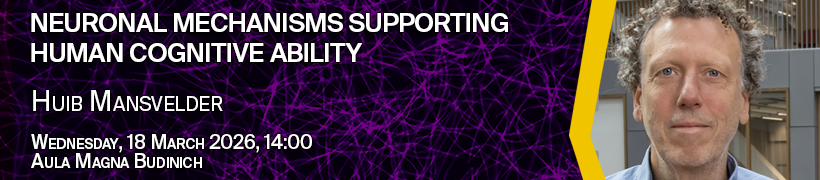
I SISSA Colloquia tornano mercoledì 18 marzo, alle ore 14, nell’Aula Magna Budinich. In questa occasione avremo il piacere di ospitare il professor Huib Mansvelder (Vrije Universiteit Amsterdam), che terrà un seminario dal titolo
Neuronal Mechanisms Supporting Human Cognitive Ability
Abstract: Why are some people able to think faster than others? How do neurobiological factors such as brain circuits, cellular properties, or molecular networks contribute to differences in cognition? Research on the neurobiology of intelligence has traditionally focused on brain structure and function through brain imaging techniques, or on genes and genetic loci through genome-wide association studies. Yet the intermediate level remains largely unexplored. The emergence of single-cell transcriptomics combined with functional and morphological analysis of neurons in the human neocortex offers a way to bridge this gap. In this talk, Huib Mansvelder will present recent findings on the structural and functional adaptations of human neurons that distinguish them from those of laboratory animals, and discuss new approaches linking genetic, cellular, and brain-imaging data to better understand human cognitive ability.
Huib Mansvelder è professore di Neurofisiologia Integrativa presso la Vrije Universiteit Amsterdam. Durante il dottorato ha studiato il controllo, da parte dei canali del calcio, del rilascio di vescicole nelle cellule pituitarie neuroendocrine. Come postdoc con Dan McGehee all’University of Chicago, ha analizzato la plasticità sinaptica indotta farmacologicamente nei neuroni dopaminergici e ha chiarito in che modo i recettori nicotinici modulano la trasmissione sinaptica nell’area tegmentale ventrale. Alla Columbia University, lavorando con Rafael Yuste, ha studiato la dinamica del calcio nelle spine dendritiche tramite microscopia a due fotoni. La sua ricerca attuale si concentra su come la corteccia prefrontale e le aree sottocorticali coordinino i processi di attenzione nei roditori. Parallelamente, il suo laboratorio studia l’organizzazione anatomica e funzionale dei microcircuiti neocorticali umani e il rapporto tra le proprietà dei neuroni umani e la cognizione.
Il colloquium sarà in diretta su Youtube a questo link.
Al termine del Colloquium sarà offerto un rinfresco.