


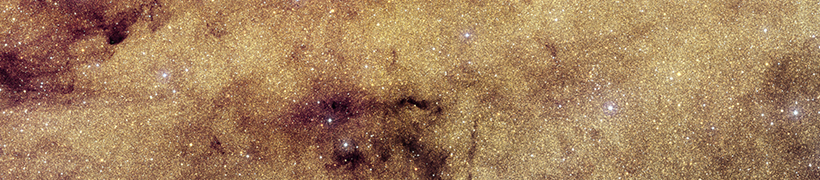
The European Space Agency’s Euclid mission and the Euclid Consortium have released new data from dedicated observations of the central regions of the Milky Way, obtained as part of Euclid’s Quick Release 2. Euclid’s primary goal is to map the large scale structure of the Universe and reveal the role of dark matter and dark energy, and these observations show the extraordinary potential of the mission.
On 23 March 2025, Euclid observed the inner Galactic bulge for about 26 hours, producing an exceptionally deep, wide field and high resolution view of one of the most crowded stellar regions in the sky. The resulting mosaic, based on nine pointings of the visible light instrument, contains more than 60 million stars, together with nebulae and star clusters. It is the largest and most detailed visible light image ever obtained of the centre of our Galaxy.
“These new observations are spectacular,” explains Carlo Baccigalupi, professor of Astrophysics and Cosmology at SISSA and builder scientist for the Euclid Consortium. “They show that Euclid is working extremely well: the telescope combines sharp imaging, stability and survey speed in a way that opens scientific possibilities far beyond its core cosmological programme.”
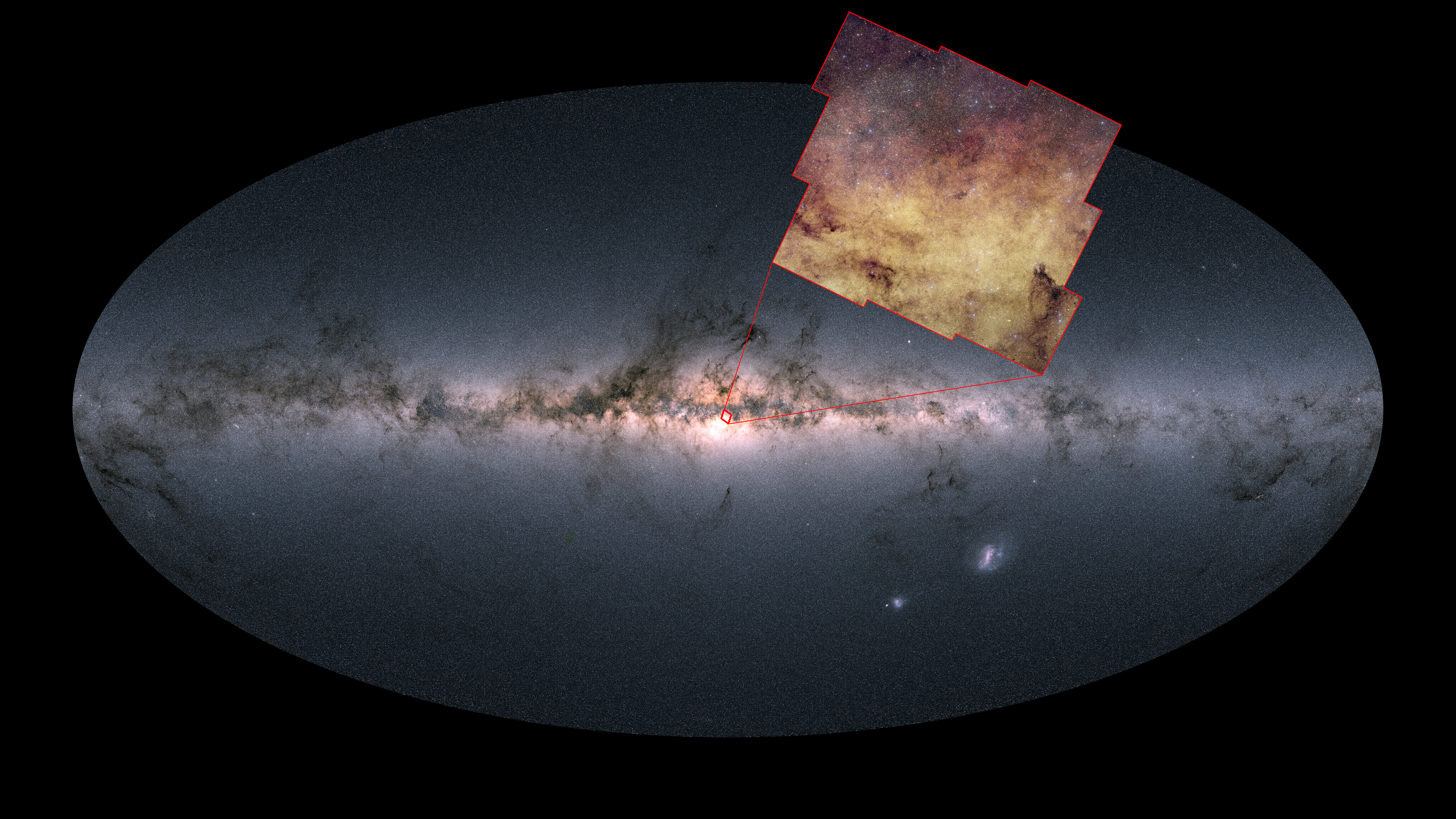
The galactic bulge – the central region of our galaxy – is a vast, tightly packed structure filled mainly with old, cooler stars, giving it its characteristic yellow colour. Image Credits: ESA
The Euclid Galactic Bulge Survey is especially important for the study of exoplanets through gravitational microlensing. When a foreground star, and possibly one of its planets, passes in front of a more distant star, its gravity briefly amplifies the background light. Euclid’s ability to resolve individual stars in such dense regions will help scientists refine the properties of known microlensing systems and measure the masses of planets, including cold planets that are difficult to study with other techniques.
“A major success for the European space programme,” Baccigalupi adds. “Euclid is demonstrating the strength of a mission built through European leadership, ESA coordination, and a broad international scientific collaboration. It is already delivering high quality data across several areas of astrophysics.”
The next major milestone will be Euclid’s first cosmological data release, DR1, expected in late 2026. This will include one year of observations and will represent an unprecedented map of the Universe from space, in visible and infrared light. For cosmology, Euclid’s power will lie not only in its own data, but also in combination with other probes.
“We are entering the era of combined cosmological datasets,” Baccigalupi concludes. “At SISSA, we have been preparing the Euclid Consortium for connecting the structures observed by Euclid with the cosmic microwave background, searching for the subtle effects that galaxies and large scale structures imprint on this ancient radiation. These correlations may reveal crucial information on the nature of Dark Matter and Dark Energy. These observations open new windows on astrophysics, and show the way to these ambitious goals for fundamental Physics.”
Read the full press relase from ESA and the Euclid Consortium: