


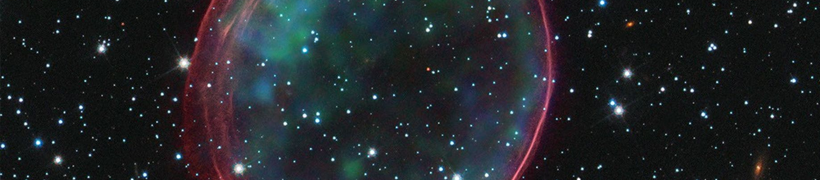
Supernovae help astronomers measure how the Universe expands over time, but correctly interpreting this signal is far from straightforward: the light that reaches us is affected by multiple factors, making truly precise measurements extremely difficult. In a new study published in Nature Astronomy, Konstantin Karchev and Roberto Trotta of SISSA, together with Raúl Jiménez of the University of Barcelona, introduce CIGaRS (Combined Inference and Galaxy-Related Standardisation), a method based on artificial intelligence and neural networks that disentangles the intrinsic effects on the luminosity of these stellar explosions from environmental ones, such as interstellar dust and the expansion of the Universe. This makes it possible to extract far more information without requiring additional data, such as spectroscopic analyses.
Type Ia supernovae are among the most valuable phenomena in cosmology because they can serve as distance indicators: by observing how bright they appear, astronomers can use them as “standardisable candles” to measure cosmic distances and reconstruct the history of the Universe’s expansion. Their observed brightness, however, depends not only on the physics of the explosion itself, but also on factors linked to the progenitor star, such as age and chemical composition, as well as on dust and, more generally, on the properties of the host galaxy in which the explosion occurs. Information of this kind can be studied in particularly rich detail through spectroscopy, which measures not only how much light arrives, but also how that light is distributed across different wavelengths. Obtaining detailed spectra for large samples of supernovae, however, is far more difficult than simply collecting their brightness.
CIGaRS tackles the problem in an innovative way. It brings together in a single model galaxy evolution, dust effects, the rate at which Type Ia supernovae appear over cosmic time, and the observable properties of the explosions -something that had never been done before. In this way, it is able to interpret simultaneously all the factors that shape the light we observe, rather than correcting for them separately through successive steps. This makes it possible to reconstruct and exploit far more information using photometric data alone.
This approach will be essential over the next ten years. Major photometric surveys have only just begun, including the Legacy Survey of Space and Time at the Vera Rubin Observatory in Chile, which is expected to discover millions of new supernovae, including at least one hundred thousand Type Ia events each year.
Read the full press release: