


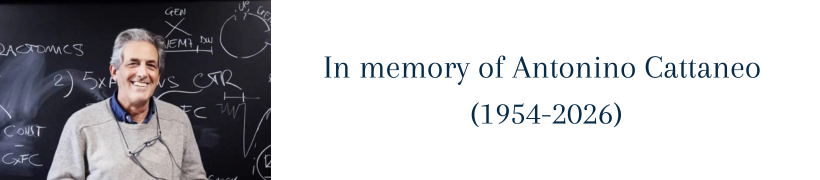
The sudden loss of Prof. Antonino Cattaneo on June 29th 2026 has shocked the SISSA community that has lost one of its most prestigious members. Born in Pisa 72 years ago, Antonino studied physics in Rome at La Sapienza and later worked with Cesar Milstein and Michael Neuberger at the MRC Laboratory of Molecular Biology (Cambridge, UK).
Antonino has been one of the most influential neuroscientists of his generation and in his long academic career was full professor of Biophysics at SISSA from 1991 to 2008, a period during which, thanks to the passionate drive of Daniele Amati, SISSA saw a huge expansion of its activities, including the opening to radically new ones, such as Neurosciences.
Antonino was a crucial person in shaping SISSA’s Neuroscience group and he strongly contributed to the creation of the Neuroscience department as a multidisciplinary institution comprising biologists, physicians, computational neuroscientists and biophysicists. At that time Neuroscience was not a recognized academic discipline, yet the continuous progress in studies of the brain and its mechanisms indicated the need to bring together the expertise and knowledge from distinct subjects in order to achieve a more comprehensive understanding of how the brain operates. Thus, from molecules to human neuropsychology, building upon the vision and ideas of Antonino, Neurosciences at SISSA continuously grew up to the present community that includes a large and diverse pool of investigators and students.
Antonino brought his innovative thinking, his international collaborations and his intellectual abilities to establish a new PhD program when Italy had not yet established any formal PhD training: this development consequently represented a realistic example of how very successful learning and knowledge can be generated by interaction amongst various scientific disciplines. In doing so, Antonino became a reference point for the whole SISSA Neuroscience community and a beloved friend for his colleagues and former SISSA directors Daniele Amati and Stefano Fantoni.
It is important to recall how even within his own studies Antonino always combined multidisciplinary approaches that included genetics, biophysics, molecular dynamics, molecular biology and computational biology. All this was applied to investigating the mechanisms of action of the neurotrophin NGF and the molecular defects underlying the neuronal pathology of Alzheimer’s disease.
The message is thus very clear: scientific research needs broad thinking and extensive collaborations. It is therefore to us to continue on this pathway of scientific research using the dynamic vision that Antonino had indicated to us.