


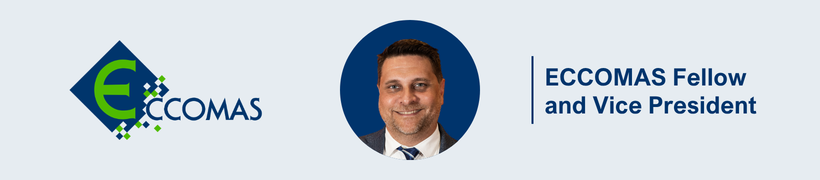
“ECCOMAS has become a very important reference point at the European level for research in numerical methods for the applied sciences. It has helped build a strong and cohesive community that brings together applied and industrial mathematics with computational mechanics, broadening the horizons of European national societies. It is a true honour to be among the first to receive this distinction.” These are the words of Gianluigi Rozza, professor of Numerical Analysis and Scientific Computing at SISSA, who was named this morning a Fellow of ECCOMAS, the European Community on Computational Methods in Applied Sciences, during the joint WCCM-ECCOMAS 2026 conference in Munich.
The Fellow distinction, established this year, was conferred on 36 European researchers in the field of mathematics; Rozza is one of five Italians among the appointed Fellows. The ECCOMAS Executive Committee recognised “outstanding contributions to computational methods in applied sciences and service to the ECCOMAS community”, noting that the SISSA mathematician “has played an important role in the development and success of the association”.
Last Sunday, Rozza was also elected Vice President of ECCOMAS. As he commented, this appointment “is an expression of trust not only in me personally, but also one of great importance at the national level and for SISSA mathLab, which since its foundation has promoted initiatives bringing together universities and businesses in the region to accelerate innovation and technology transfer processes”.
Founded in 1993, ECCOMAS is a scientific organisation that brings together 23 European associations dedicated to the development of computational methods in science and technology. These methods combine mathematical models, algorithms and numerical simulations to study complex phenomena and address applied problems in fields such as engineering, industry, the environment and medicine. The association’s aim is to promote multidisciplinary collaboration and facilitate knowledge exchange among European universities, industries and research institutes active in numerical methods and simulation in engineering and the applied sciences, with the ultimate goal of devising new solutions to technological and societal challenges.