


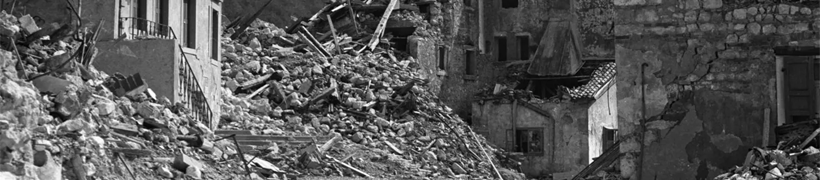
Fifty years after the devastating earthquake that struck Friuli on May 6, 1976, SISSA remembers the victims, the wounded communities, and the extraordinary collective response that followed one of the most severe tragedies in Italy’s post-war history.
The earthquake claimed nearly one thousand lives, left one hundred thousand people homeless, and destroyed entire towns and villages. In the wake of the disaster, an exceptional mobilization of solidarity and civic commitment took shape, involving the entire country and with Trieste at the forefront.
For us, this remembrance goes beyond the necessary sharing of grief. SISSA was also born out of that season of reconstruction, solidarity, and vision: we are part of the post-earthquake legacy, of a project that was able to transform a deep wound into a new idea of the future for Friuli Venezia Giulia and for the country as a whole.
With Presidential Decree No. 102 of March 6, 1978, signed by President of the Republic Giovanni Leone, five new institutions were established that would profoundly reshape the scientific, cultural, and educational profile of the region: in addition to our School, the University of Udine, the Trieste Science and Technology Research Area, the Higher School for Interpreters and Translators, and the United World College of the Adriatic in Duino.
The founding of SISSA took shape within the vision of Paolo Budinich, a central figure in the development of Trieste’s scientific system. After co-founding the International Centre for Theoretical Physics with Abdus Salam, Budinich envisaged for Trieste a graduate school for advanced training and research capable of attracting talent from around the world, in dialogue with the international scientific institutions already established in the area.
Today we carry forward this legacy by continuing to be a place of research, doctoral training, and international openness. Fifty years after the earthquake, we recognize the reconstruction of Friuli as a decisive chapter in our history: a moment in which suffering was transformed—through solidarity and the foresight of institutions and individuals—into a lasting vision of knowledge and the future.