


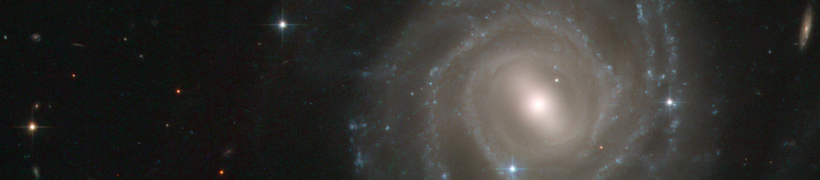
The Universal Rotation Curve does not stop where the stars end. It continues into the most remote regions of spiral galaxies, where dark matter dominates. This is the finding of a study conducted by Paolo Salucci and collaborators at SISSA, together with Esha Bhatia of the Indian Institute of Technology, published in "Discover Space".
The research strengthens one of the leading models used to describe spiral galaxies and suggests that the relationship between visible matter and dark matter is much deeper than current models predict. According to the authors, this new picture could shed light on galaxy formation and provide fresh clues about the possible existence of a previously unknown dark matter particle capable of interacting with ordinary matter.
Image: ESA/Hubble & NASA