


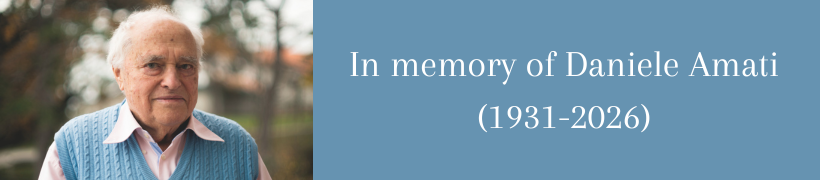
"We owe the SISSA we know today to him." The words with which SISSA celebrated Daniele Amati’s 90th birthday in 2021 resonate today with even greater intensity and emotion. Having passed away during the night, Amati leaves a profound and lasting mark on the history of the School. An internationally renowned theoretical physicist, Director of SISSA from 1986 to 2001 and former head of the Theoretical Division at CERN in Geneva, he would have turned 95 on 11 August.
Appointed by Paolo Budinich to carry on the founder’s legacy, he led a decisive phase of growth and transformation at SISSA, consolidating its international profile and broadening its research areas. Under his leadership, the Neuroscience area was established, complementing the long-standing Physics and Mathematics areas thanks to a forward-thinking interdisciplinary approach and collaboration with some of the most eminent scholars on the global scientific stage. Amati was also one of the pioneers of open-access scientific publishing: at SISSA, he promoted the launch of the Journal of High Energy Physics (JHEP), one of the first entirely digital scientific journals managed directly by the research community. Among the institutional innovations to which he contributed was the development of SISSA’s activities in the dialogue between research and society and in science communication.
After completing his term as Director, he continued to be present at SISSA with the same enthusiasm and intellectual curiosity that had characterised his entire career. He played an active part in the life of the School, following its evolution and supporting the development of generations of students and researchers. Right up until his final years, he retained an unwavering faith in the value of research and knowledge, leaving behind a scientific, cultural and human legacy that continues to inspire the SISSA community and the world of international research.
Born in Rome in 1931 into a Jewish family, he was forced to move to Argentina in 1939 to escape the racial laws. It was in Buenos Aires that his passion for physics, which would accompany him throughout his life, was kindled. His education was shaped by encounters with some of the most influential figures in twentieth-century physics, including Richard Feynman, Enrico Fermi and Freeman Dyson. After spending years in Argentina, Brazil and Italy, he joined CERN in Geneva in 1959, where he worked for three decades before becoming Director of the Theoretical Division. Throughout his career, he collaborated with many of the leading figures in modern physics and met prominent figures from the worlds of culture and international politics, from Italo Calvino to Fidel Castro.