


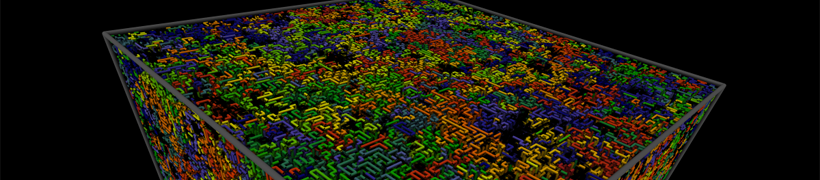
Long polymer chains are everywhere: in synthetic materials, soft matter, biological systems such as chromosomes, and mathematical models of filaments and knots. When many such chains are densely packed, they form what physicists call a polymer melt. In this crowded environment, each chain is constrained by the others around it. These entanglements are central to the behaviour of polymeric materials, but they also make the systems extremely difficult to simulate: as chain length increases, the time needed to obtain a new independent configuration grows very rapidly. For very large systems, conventional simulations can therefore become computationally prohibitive.
For more than 70 years, scientists have used many “tricks” to speed up this process, including so-called Monte Carlo methods with ingenious moves designed to accelerate the evolution of the system. These methods helped, but the basic problem remained: in a dense melt, changes still had to propagate through a highly tangled system, slowing down the simulation.
A new SISSA study by Enrico Fornasa, Francesco Slongo and Cristian Micheletti published in Nature Communications introduces a different way around this bottleneck. Drawing inspiration from ideas in quantum computing, the researchers looked at the problem from a new perspective. Their new method, called Self-Assembly Monte Carlo, or SAMC, stops treating the system as a fixed tangle that must slowly relax; instead, it allows local bonds to break and reform, so that the polymer melt can reorganize more efficiently while still producing physically meaningful equilibrium configurations.
The result opens a route to studying dense chain systems beyond idealized polymer physics, including designed materials, polymer networks and biological soft matter. Future applications include polymers in spatial confinement, such as channels, slits and cavities, and the use of SAMC-generated configurations as starting points for more detailed molecular dynamics simulations.
Read the paper:
https://www.nature.com/articles/s41467-026-74480-4
Read the full press release: